
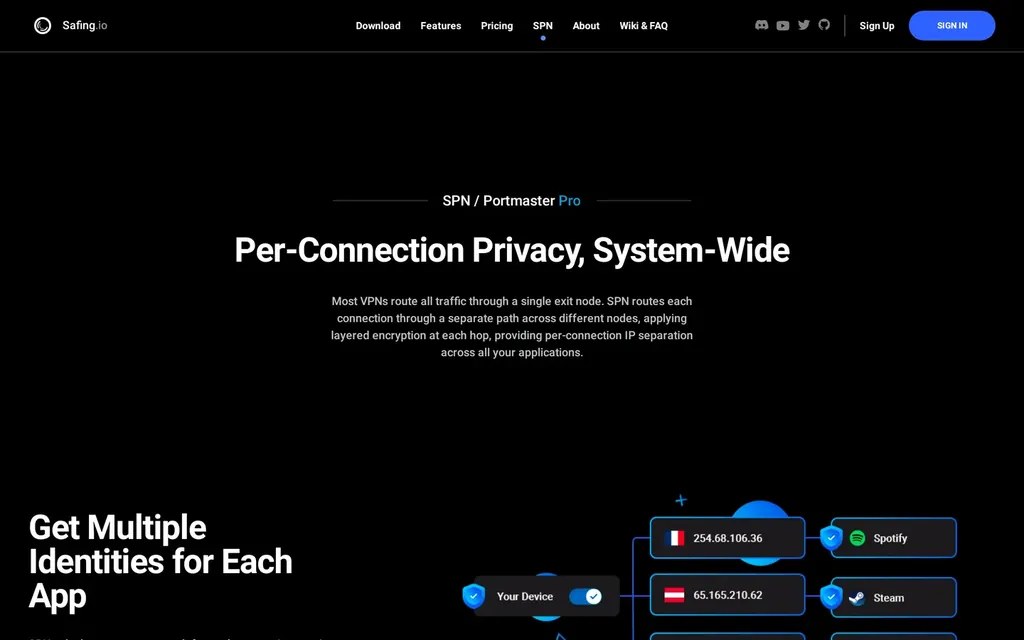
SPN enables users to select different identities (IP addresses) for each app. Certain apps and domains can be excluded as well. Volunteers are able to host a community node but there are no rewards yet, so it can be assumed that the majority of nodes are run by the Safing team.
Reviewed by Marcus Holmberg

Rate Safing Privacy Network - SPN: No account needed
Threat level
Hardened
A hardened pick. Worth the effort once you have chosen to shrink your footprint on purpose. Enough for most people. Threat levels
Our take
SPN’s per-app identity routing is genuinely different from a normal VPN: you can give each app its own exit IP instead of funneling everything through one tunnel, which fragments the picture an observer can build. It is a small Austrian project and the network is not the size of a commercial VPN, so expect fewer locations and less speed. Worth it for people who want app-level control and are fine being early to a niche tool rather than buying mainstream polish.
Website at a glance
safing.io
C score 50
Basic website security headers
Graded by Mozilla HTTP Observatory, tested 10d ago
Inspect this site yourself
Measures the security configuration of the tool's own website, not the privacy of the product itself. A strong tool can still score low here.
Safing Privacy Network - SPN alternatives
NymVPN Decentralized VPN built on the Nym mixnet, with a 5-hop anonymous mode and a faster 2-hop WireGuard mode in one client.

Mysterium VPN Unlimited devices, affordable price, 135 countries and over 16,000 servers. No email sign up required.

Sentinel Interesting project in an early stage. Instead of wasting server resources, this new protocol is using peer-to-peer user nodes to create a fully functioning bandwith network.

Orchid VPN No Windows client available. The Orchid protocol uses WebRTC. Onion-routed multi-hop connections.

KelVPN No iOS app yet. Node operators get rewarded with $KEL tokens with staking options.

Tachyon VPN No Windows client available, but coming soon. Number of nodes in Jan 2023: 1128. Source . Node operators receive IPX token rewards with staking options.
* Average ratings will show on this page once the threshold of 5 ratings is reached.