 Notes

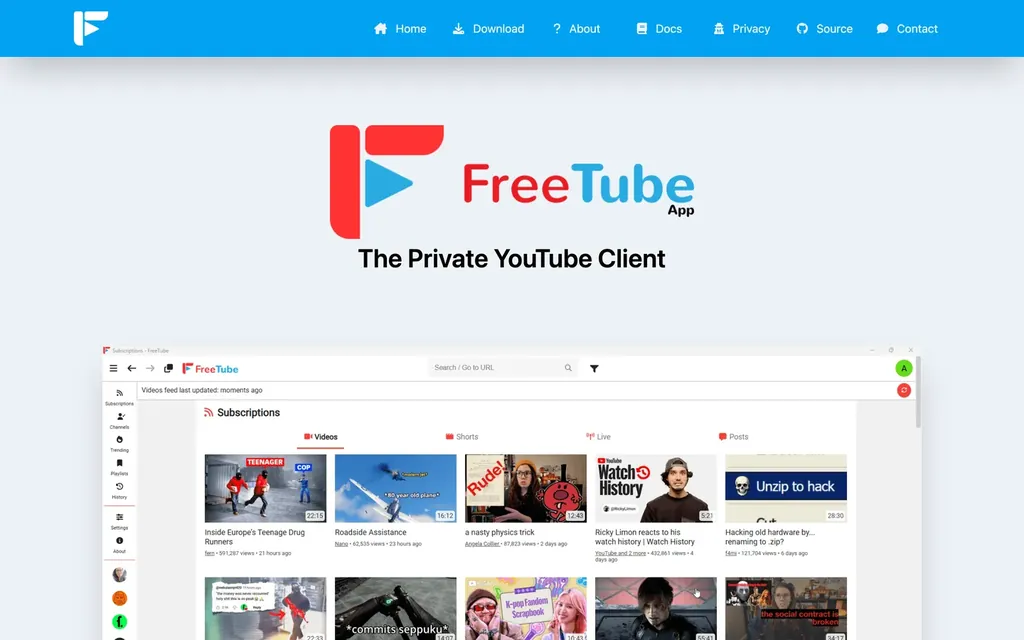
FreeTube is an open-source desktop YouTube client for Windows, macOS, and Linux. It uses a built-in local extractor or the Invidious API to fetch content, blocks ads by default, and stores subscriptions, history, and playlists entirely on your device.
Reviewed by Marcus Holmberg

FreeTube
freetubeapp.io 4.9 (9)
Rate FreeTube: No account needed
Threat level
Covered
A covered pick. Anyone can use it as a private drop-in, with no setup or know-how. Enough for most people. Threat levels
Our take
FreeTube is the cleanest desktop option for watching YouTube without feeding Google’s ad profile: no cookies, no JavaScript fingerprinting, all your data stays local. The two-extractor design is a genuine resilience win, since you can switch between the local API and Invidious if one breaks. The honest catch is that your IP address is still visible to YouTube or whichever Invidious instance you use, so pair it with a VPN or Tor if IP exposure matters to your threat model. Desktop-only users who watch a lot of YouTube and want a proper native experience should reach for this first.
GitHub at a glance
FreeTubeApp/FreeTube AGPL-3.0 freetubeprivacysubscriptionsvideovideosyoutube
Stars
22,311
+120 this week
Forks
1,569
214 watching
Last commit
today
healthy
Star history
Issues
94% closed
280
open
4,667
closed
+51 / -57
opened / closed, last 4 weeks
Opened vs closed, last 12 weeks
Commits, last 26 weeks
631 commits, active 26 of 26 weeks
281 contributors since Feb 2018
Languages
- Vue 46.8%
- JavaScript 42.9%
- CSS 8%
- Other 2.3%
Updated daily from the GitHub API. Star tracking since Jun 22, 2026.
Website at a glance
freetubeapp.io
B score 75
Solid website security headers
Graded by Mozilla HTTP Observatory, tested 13d ago
Inspect this site yourself
Measures the security configuration of the tool's own website, not the privacy of the product itself. A strong tool can still score low here.
FreeTube alternatives

LibRedirect Automatically redirects requests from popular websites to alternative and privacy friendly frontends. Uses random instances by default. You can modify this and add custom…

NewPipe NewPipe is a libre Android app for streaming content from YouTube, SoundCloud, PeerTube, Bandcamp, and media.ccc.de without Google Play Services, accounts, or ads. It stores subscriptions and playlists locally and is available on F-Droid.

LibreTube LibreTube is an open-source Android YouTube client that routes requests through the Piped API instead of Google directly. It supports SponsorBlock, ReturnYouTubeDislike, DeArrow, subscriptions, playlists, and background playback, with a Material 3 interface.

Invidious Desktop: FreeTube . For Windows, Mac and Linux.

libremdb All requests go through the backend; client never talks to IMDb. List of Instances .

Piped Piped is an open-source, self-hostable web frontend for YouTube that makes no connections to Google servers during playback. It supports SponsorBlock, playlists, subscriptions, and a public JSON API, and runs as a federated multi-instance network.
FreeTube license, in plain English
AGPL-3.0 Strong copyleft · network
Free to use, even commercially. Changes must be published under the same license, and running a modified version as a network service counts as distributing it.
Permits
- Commercial use
- Modification
- Distribution
- Patent use
- Private use
Requires
- Disclose source
- Network use is distribution
- Same license
- State changes
- License and copyright notice
Does not provide
- Liability cover
- Warranty
Why it matters: The network clause is the point. Anyone who runs a modified version as a hosted service has to publish those changes, so the code handling your data stays inspectable. This is why privacy-first projects reach for AGPL.
Plain-language summary of the project's license, not legal advice. Read the full text for the exact terms.