
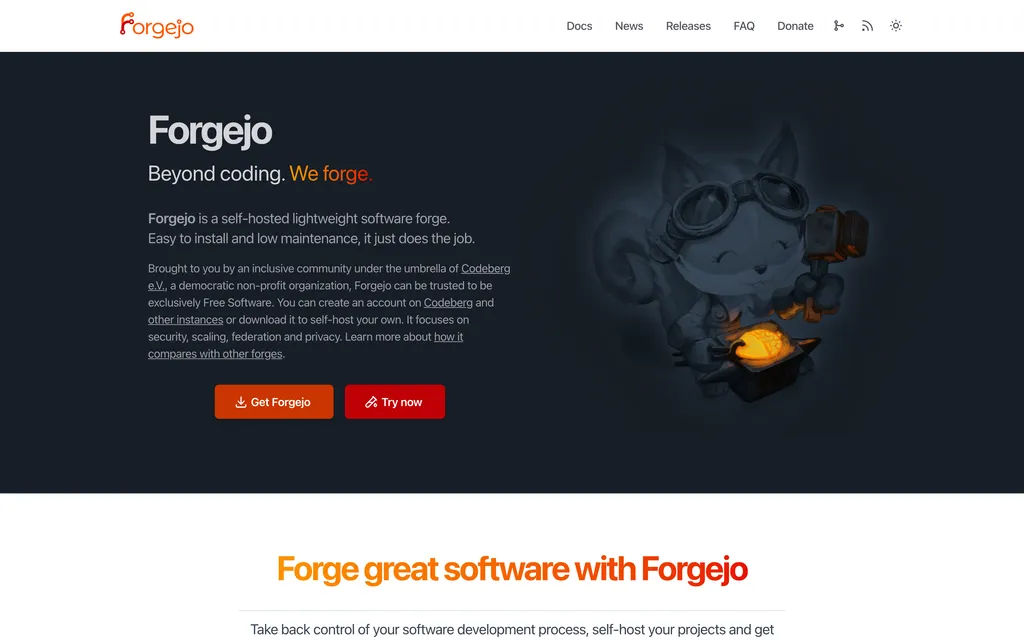
Forgejo is a community-driven, self-hosted Git forge, forked from Gitea after that project moved under a for-profit company. It is stewarded by Codeberg e.V., a German nonprofit, with governance built so no single company can take it over. Forgejo runs as a lightweight binary or container and is released under the GPLv3 or later copyleft license.
Reviewed by Marco Wollank

Rate Forgejo: No account needed
Threat level
Hardened
A hardened pick. Worth the effort once you have chosen to shrink your footprint on purpose. Enough for most people. Threat levels
Our take
Forgejo is the forge to reach for when you want to own your code outright, because it is light enough to run on a modest server yet complete enough to replace GitHub for real work. The copyleft GPLv3+ license is the quiet hero: it makes the kind of for-profit capture that pushed people off Gitea structurally difficult, so the project stays accountable to its contributors. The honest catch is that you are the operator now, and the ecosystem of ready-made CI actions is smaller than the marketplace Microsoft has built around GitHub. Pick Forgejo if you want full control of your infrastructure and a community-governed forge, and lean on the hosted route if running a server is not how you want to spend your time. For the same software with no maintenance, Codeberg hosts Forgejo for you.
Website at a glance
forgejo.org
D score 30
Weak website security headers
Graded by Mozilla HTTP Observatory, tested 3d ago
Inspect this site yourself
Measures the security configuration of the tool's own website, not the privacy of the product itself. A strong tool can still score low here.
Forgejo alternatives

Codeberg Free, nonprofit Git hosting for open-source projects, run on Forgejo with no ads and no tracking. Operated by Codeberg e.V. in Germany.

GitLab CE Full DevOps platform whose Community Edition is open source under the MIT license and self-hostable, with a hosted cloud option too. Based in the US.

SourceHut Minimalist, fully open-source forge built around an email-driven workflow, with no required JavaScript. Available as paid hosting or self-hosted. Based in the US.
Frequently asked
- Is Forgejo a fork of Gitea?
- Yes. Forgejo is a community-driven hard fork of Gitea, created after the Gitea project moved under a for-profit company. It is stewarded by Codeberg e.V., a nonprofit, with governance designed so no single company can capture it. The two share a heritage, but Forgejo is steered by its contributors rather than by a vendor.
- What license does Forgejo use?
- Forgejo is released under the GNU General Public License version 3 or later, a copyleft license it adopted after starting out under the permissive MIT terms of its Gitea origin. Copyleft means anyone who distributes a modified version has to share their changes, which makes a quiet proprietary takeover far harder.
- Is Forgejo hard to self-host?
- It is one of the lighter forges to run. Forgejo ships as a single binary or container that runs comfortably on a small server and updates with one pull. You handle backups and the occasional upgrade yourself, which is the tradeoff for keeping your code on infrastructure you own rather than Microsoft's.
- Does Forgejo have pull requests and CI?
- Yes. Forgejo offers a full merge-request flow with inline review and branch protection, plus Forgejo Actions for integrated CI that mirrors the GitHub Actions format. The CI marketplace is smaller, so you may wire up a runner by hand, but the daily review-and-merge loop is intact.
* Average ratings will show on this page once the threshold of 5 ratings is reached.