
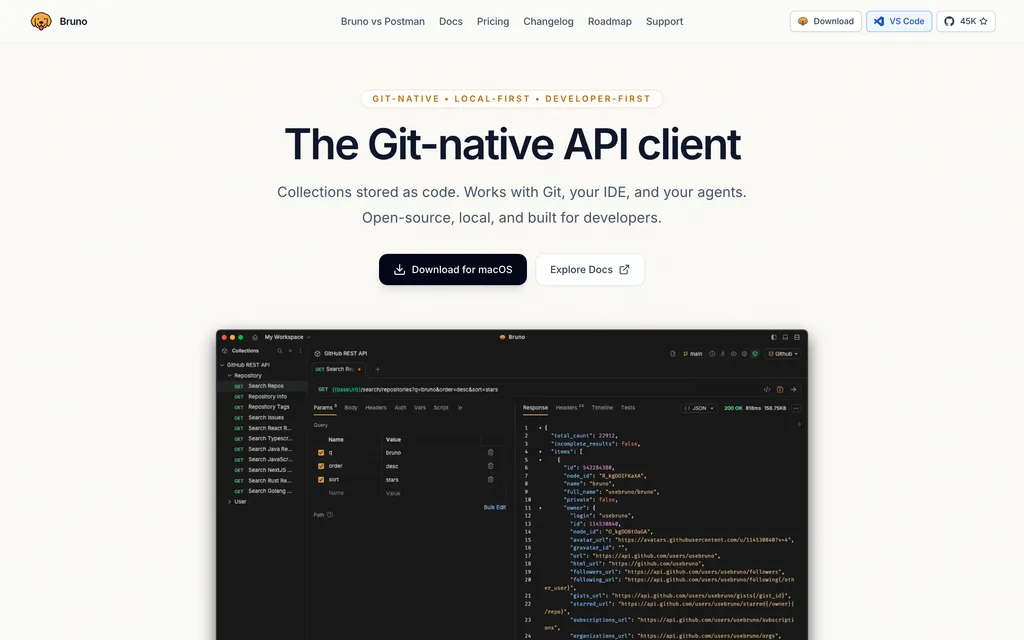
Bruno is an open-source API client that runs entirely on your own machine. Instead of saving your collections to a vendor cloud, it stores each request as a plain text file in a folder you choose, so the natural workflow is to commit that folder to your own Git repository. There is no login and no background sync.
Reviewed by Marcus Holmberg

Bruno
usebruno.com 3 ratings so far*
Rate Bruno: No account needed
Threat level
Covered
A covered pick. Anyone can use it as a private drop-in, with no setup or know-how. Enough for most people. Threat levels
Our take
Bruno is the pick when you do not want your requests and their environment secrets living on someone else’s servers as a condition of using the tool. It is offline-first with no account, and the collection is just text files you can read and diff, with the core open source under the MIT license. The honest catch is maturity: it is younger than Postman, with a smaller plugin ecosystem and some team collaboration features behind a paid tier. None of that touches the local client, which stays free. Reach for Bruno if you version your API work in Git and want secrets kept on disk under your control. If you lean on a large marketplace of integrations, weigh that gap.
GitHub at a glance
usebruno/bruno
Stars
47,200
+150 this week
Last commit
1d ago
healthy
License
MIT
Latest release
v4.2.0
2d ago
Stars, last 90d
Website at a glance
usebruno.com
D- score 25
Weak website security headers
Graded by Mozilla HTTP Observatory, tested 4d ago
Inspect this site yourself
Measures the security configuration of the tool's own website, not the privacy of the product itself. A strong tool can still score low here.
Bruno alternatives

Frequently asked
- Does Bruno send my requests to the cloud?
- No. Bruno is offline-first by design and has no concept of a login or an account. Your collections and the secrets inside them stay on your own disk unless you choose to commit them to a repository you control. Nothing is synced to a vendor server in the background.
- Where does Bruno store my collections?
- As plain text files in a folder on your machine, one file per request, in a human-readable format. You point Bruno at any directory and it reads the collection from disk, so the natural way to share or back it up is to commit that folder to Git alongside the code it tests.
- Is Bruno free and open source?
- The core app is open source under the MIT license and free to use with no paid unlock for everyday work. There are paid tiers aimed at teams and enterprise support, but solo and offline use of the client costs nothing.
- Is Bruno a drop-in replacement for Postman?
- For sending requests and running scripted collections in CI it covers the same ground. It is younger than Postman with a smaller plugin ecosystem, so some niche integrations and polished team features are thinner. For most request work it is a clean swap that keeps your data local.
Bruno license, in plain English
MIT Permissive
Do almost anything: use, change, and ship it, even inside closed-source products. The only condition is keeping the copyright notice.
Permits
- Commercial use
- Modification
- Distribution
- Private use
Requires
- License and copyright notice
Does not provide
- Liability cover
- Warranty
Why it matters: Permissive licensing lets anyone reuse this, including inside closed products. That is freedom to build on, but no guarantee that downstream copies stay open.
Plain-language summary of the project's license, not legal advice. Read the full text for the exact terms.
* Average ratings will show on this page once the threshold of 5 ratings is reached.