
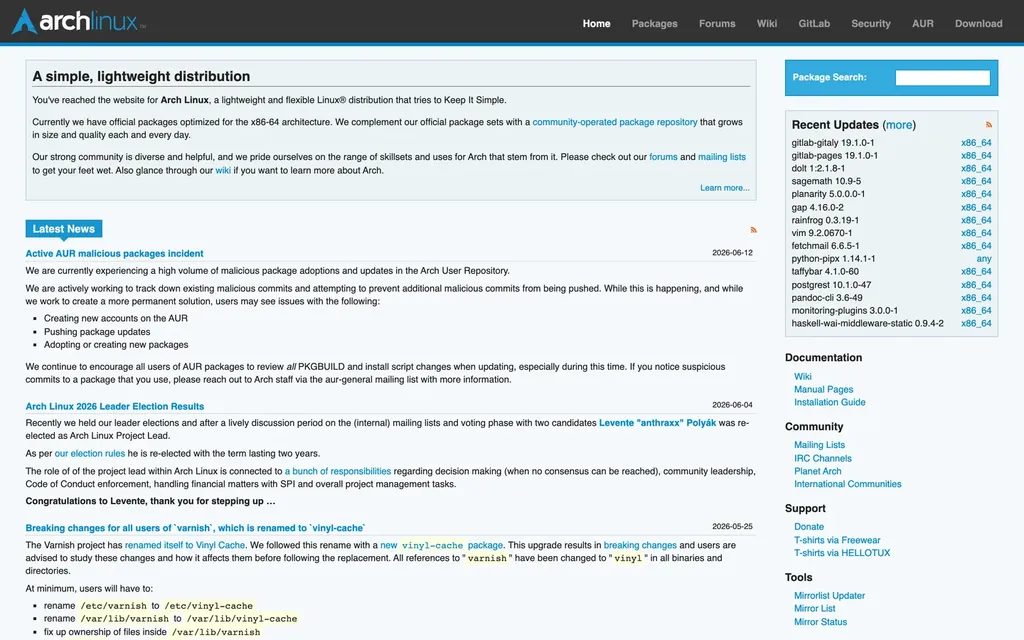
Arch Linux is a minimal, rolling-release Linux distribution built around a do-it-yourself philosophy. You assemble the system yourself from a bare base, choosing every component, and keep it current with the pacman package manager.
Reviewed by Marco Wollank

Arch Linux
archlinux.org 3 ratings so far*
Rate Arch Linux: No account needed
Threat level
Hardened
A hardened pick. Worth the effort once you have chosen to shrink your footprint on purpose. Enough for most people. Threat levels
Our take
Arch rewards the work you put into it: because you built every layer yourself, you understand exactly what is running, and the Arch Wiki is one of the best technical references in the Linux world. The rolling model means no reinstalls and genuinely current software. The catch is that the initial install and ongoing upkeep require real engagement, and skipping update news before a major upgrade is how systems break. Skip it if you want a working desktop in an afternoon; reach for it if you want to own your machine completely and have the patience to learn the ropes.
Website at a glance
archlinux.org
A+ score 130
Strong website security headers
Graded by Mozilla HTTP Observatory, tested today
Inspect this site yourself
Measures the security configuration of the tool's own website, not the privacy of the product itself. A strong tool can still score low here.
Arch Linux alternatives

Fedora Workstation Fedora Workstation: User friendly and easy to setup

Ubuntu Ubuntu: User friendly and easy to setup
macOS Apple's desktop OS. A real privacy step up from Windows, but closed and US-based.

secureblue secureblue is a security-hardened immutable Linux OS built on Fedora Atomic Desktops. It ships as OCI bootable container images and applies kernel hardening, a hardened memory allocator from GrapheneOS, and a hardened Chromium browser called Trivalent.

Kicksecure Kicksecure is a security-hardened Debian-based Linux distribution that applies a broad set of kernel and userspace hardening settings out of the box, reducing the attack surface without requiring manual configuration. It also serves as the foundation for the Whonix anonymity OS.

Fedora Atomic Desktops Fedora Atomic Desktops (Silverblue, Kinoite, and others) are immutable Fedora variants where the base OS is read-only and updated atomically via rpm-ostree. Applications run as Flatpaks, and rollback to a prior OS image is built in.
* Average ratings will show on this page once the threshold of 5 ratings is reached.